Cliff43J
New Member
- Messages
- 23
I have watched so many videos on YouTube about raising crickets, that I see them in my sleep...lol... What bin to use? How to lay it out? Well FWIW, here is what I ended up with.
To keep costs relatively low I went with 3 Sterilite, 90-quart, translucent bins. It is not a heavy-duty bin, but then crickets are not exactly rowdy critters. They should be a good match. The 90-quart bin appeared to be a good size for me to handle easily. There were larger bins and more heavy-duty bins at higher prices, but they didn't fit in with what I have in mind. Later on I can always upgrade if need be. Ventilation is always a good idea for living critters, regardless of their sizes. I settled on installing the vent on the top as it is a softer plastic and designed to flex. As the bin itself is a harder plastic, I figured that it would be more prone to cracking down the road. The accompanying photos pretty much show all of the steps. I went on eBay and found a piece of 400 mesh stainless steel mesh at a good price and bought it. I had seen in one video where crickets were said to have eaten their way through nylon or fiberglass screen material. Stainless steel was the furthest thing from my mind, but a good price attracted me. I drilled 3/8" holes in each of the 4 corners to relieve any stress caused by 90-degree corners. The knife that I use is a grafting knife sold by Felco and made by Victorinox of Swiss Army Knife fame. It is razor sharp. The mesh was held in place with white Duck tape that I had on hand. Nothing fancy, and it works.
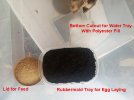
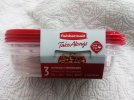
In the interior I have feed and water trays made from cashew nut containers. I buy these at Sam's and enjoy emptying them. The lids hold the chicken scratch which I grind finer. I cut the bottom out of the plastic jar, put in some polyester fill to keep the crickets from drowning and add water. Quick and relatively easy.
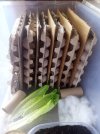
UPDATE, 10-8-25: Finally, we have enough egg carton trays to fill one bin completely. It holds 6 with cardboard inter-leavers. It may be a mistake to use corrugated cardboard, but as these are fairly good-sized crickets, I'll not worry about it. When it comes to egg-hatching bins we shall use solid cardboard spacers. See photo.
To keep costs relatively low I went with 3 Sterilite, 90-quart, translucent bins. It is not a heavy-duty bin, but then crickets are not exactly rowdy critters. They should be a good match. The 90-quart bin appeared to be a good size for me to handle easily. There were larger bins and more heavy-duty bins at higher prices, but they didn't fit in with what I have in mind. Later on I can always upgrade if need be. Ventilation is always a good idea for living critters, regardless of their sizes. I settled on installing the vent on the top as it is a softer plastic and designed to flex. As the bin itself is a harder plastic, I figured that it would be more prone to cracking down the road. The accompanying photos pretty much show all of the steps. I went on eBay and found a piece of 400 mesh stainless steel mesh at a good price and bought it. I had seen in one video where crickets were said to have eaten their way through nylon or fiberglass screen material. Stainless steel was the furthest thing from my mind, but a good price attracted me. I drilled 3/8" holes in each of the 4 corners to relieve any stress caused by 90-degree corners. The knife that I use is a grafting knife sold by Felco and made by Victorinox of Swiss Army Knife fame. It is razor sharp. The mesh was held in place with white Duck tape that I had on hand. Nothing fancy, and it works.
In the interior I have feed and water trays made from cashew nut containers. I buy these at Sam's and enjoy emptying them. The lids hold the chicken scratch which I grind finer. I cut the bottom out of the plastic jar, put in some polyester fill to keep the crickets from drowning and add water. Quick and relatively easy.
UPDATE, 10-8-25: Finally, we have enough egg carton trays to fill one bin completely. It holds 6 with cardboard inter-leavers. It may be a mistake to use corrugated cardboard, but as these are fairly good-sized crickets, I'll not worry about it. When it comes to egg-hatching bins we shall use solid cardboard spacers. See photo.
Attachments
-
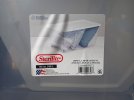 Big Bin.jpg145.2 KB · Views: 3
 -
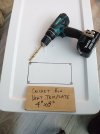 Bin Top Layout.jpg168.9 KB · Views: 2
 -
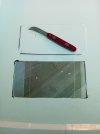 Bin Top Cutout.jpg200.9 KB · Views: 2
 -
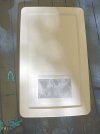 Bin Top Ventilation Installed.jpg173.6 KB · Views: 1
 -
 Bin Feeder Raw Materials.jpg224.7 KB · Views: 1
 -
 Bin Feeders in Use.jpg207.7 KB · Views: 1
 -
 Egg Laying Container Label 2.jpg204.2 KB · Views: 3
 -
 Bin Interior Completed.jpg311.1 KB · Views: 1
Last edited: