Grinning Geckos
Tegan onboard.
- Messages
- 2,515
- Location
- Chicago-land
This is the beginning to the guide for DIY "rock" hides and ledges. This is a work in progress, and I'll update every few days as I make progress on my current project. This will cover making them from start to finish, as well as painting instrustions for a realistic rock look.
This is simply one way to make your own tank decorations. The end product is very lightweight and easy to clean, but can be damaged when dropped or knocked into hard surfaces. Some care will be needed while handling to avoid damage, but any damage that occurs can be fixed by repeating the original steps in that area. This may not be the way for you to go if you want to be able to toss things around without worry.
Step 1: Gather your materials
You need:
-Foam (avoid the foam used for flowers...all others should work, I use pink insulation foam for the smooth texture and density)
-Utility Knife
-Gorilla Glue
-Bamboo sticks (like the ones used for shish-ka-bobs)
-Grout (water-mix powder, any color - tan/brown will help with the painting)
-Acrylic paints (avoid "school" paint...it becomes powdery)
----->Payne's Gray
----->Titanium White
----->Unbleached Titanium
----->Raw Sienna
----->Red Oxide (could skip this one in some cases)
-Matte Sealer (grout/tile sealer or indoor/outdoor varnish ... just make sure it says it's water base! If it doesn't mention, you can tell if it says not to use on an oil surface).
-Brushes *nothing fancy, you'll really abuse them! A few different sizes will do.
Step 2: Come up with a plan
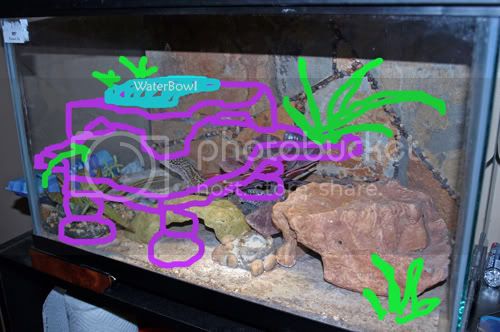
It's best to make a sketch of what you'd like to achieve to keep in mind the final product. If you have items that you know will be included (food bowls, water bowls, etc), be sure to include them in your planning process.
Tips:
-All ledges should have at least 2 large/long points of contact or 3 small points for the best stability. Test stability during the building process to be sure the weight of your gecko (or other pet) won't tip it over or cause a collapse.
-Plan your enclosure in easily removable layers. You want to be able to get into any area of the tank with minimal effort.
-Hides should have at least one area where you can fit your whole hand inside. For loose hides, this will be the bottom. For built-in hides, you will need to be creative - a lid can be useful.
-Make sure you're taking care of all your gecko's needs!
Starting pre-existing tank:
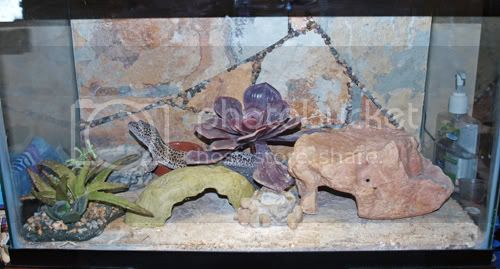
The plan: Add two ledges/hides, elevate the waterbowl, remove the small plastic hide, move and add plants.
To be continued...
Up next: Building! :main_thumbsup:
This is simply one way to make your own tank decorations. The end product is very lightweight and easy to clean, but can be damaged when dropped or knocked into hard surfaces. Some care will be needed while handling to avoid damage, but any damage that occurs can be fixed by repeating the original steps in that area. This may not be the way for you to go if you want to be able to toss things around without worry.
Step 1: Gather your materials
You need:
-Foam (avoid the foam used for flowers...all others should work, I use pink insulation foam for the smooth texture and density)
-Utility Knife
-Gorilla Glue
-Bamboo sticks (like the ones used for shish-ka-bobs)
-Grout (water-mix powder, any color - tan/brown will help with the painting)
-Acrylic paints (avoid "school" paint...it becomes powdery)
----->Payne's Gray
----->Titanium White
----->Unbleached Titanium
----->Raw Sienna
----->Red Oxide (could skip this one in some cases)
-Matte Sealer (grout/tile sealer or indoor/outdoor varnish ... just make sure it says it's water base! If it doesn't mention, you can tell if it says not to use on an oil surface).
-Brushes *nothing fancy, you'll really abuse them! A few different sizes will do.
Step 2: Come up with a plan
It's best to make a sketch of what you'd like to achieve to keep in mind the final product. If you have items that you know will be included (food bowls, water bowls, etc), be sure to include them in your planning process.
Tips:
-All ledges should have at least 2 large/long points of contact or 3 small points for the best stability. Test stability during the building process to be sure the weight of your gecko (or other pet) won't tip it over or cause a collapse.
-Plan your enclosure in easily removable layers. You want to be able to get into any area of the tank with minimal effort.
-Hides should have at least one area where you can fit your whole hand inside. For loose hides, this will be the bottom. For built-in hides, you will need to be creative - a lid can be useful.
-Make sure you're taking care of all your gecko's needs!
Starting pre-existing tank:
The plan: Add two ledges/hides, elevate the waterbowl, remove the small plastic hide, move and add plants.
To be continued...
Up next: Building! :main_thumbsup: