Enclosure advice for leopard and fancy leopard pair

MarveladeNC

New Member
Messages
1
I have a female leopard gecko and make fancy leopard gecko that came together as a pair and share an enclosure. They get along quite while and seem to be "coupled up" quite happily. They were being kept in a small maybe 20 gal tank with a felt mat and I have upgraded them to a 55 gallon tank and I have some reptisoil and reptisand mixed together as a substrate right now but I'd like to add more soil to the mix I think. I have a few hides for them and a heat lamp for day and a heat lamp for night (its like black and heats up but doesnt make light) and a heating rock but I would like some input on how to better set up their enclosure, what i might be doing wrong and what i could do better to be providing them with everything they need. I recently added a ship that came from a fish tank I used to have and they seem to love it, she especially loves climbing on it
 

Attachments
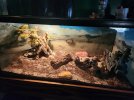
  • 20261124_144103.jpg
    20261124_144103.jpg
    4 MB · Views: 2
  • 20261123_170035.jpg
    20261123_170035.jpg
    1.6 MB · Views: 2
Last edited:

ReptilesHeaven

New Member
Messages
1
Location
Georgia, USA
A few things worth changing in that setup — you're asking the right questions:
First, I'd separate them. A male and female leopard gecko together means constant breeding pressure on the female, even if they seem to get along now — she's the one who pays for it with stress, weight loss and egg-laying. Leopard geckos are solitary by nature, and a 20-gallon long each is plenty for them individually.
Second, take the heat rock out. They're notorious for hot spots and burns, and a gecko lying on one can't always tell it's too hot until it's hurt. A heat mat on a thermostat, or an overhead deep heat projector on a thermostat, is much safer.
On substrate, I'd drop the sand from the mix — loose sand gets ingested when they strike at food and can cause impaction. Paper towel or tile is the safe simple option; if you want a natural look, a soil-based mix with no sand works, and feed from a dish or tongs.
For heating, aim for a warm-side surface around 88–92°F and a cool side around 70–77°F, with a thermostat on every heat source. And skip the heat lamp at night — they're crepuscular and a light at night disturbs them; a ceramic heat emitter gives warmth with no light.
Make sure they have three hides each once separated: warm, cool, and a humid hide with damp moss or paper towel for shedding. The ship decoration is fine as long as there are no sharp edges and nobody can get wedged in it.
 

Visit our friends

Top